You walk past your indoor AC unit and notice water dripping onto the wall, the floor, or worse, your ceiling. In Dubai, where air conditioners run almost non-stop for most of the year, this is one of the most common calls we get at Clean Air.
The good news: a leaking AC is rarely a sign your unit is dying. It’s almost always one of a handful of well-known problems, most of which are fixable in under an hour by a professional and a few you can even check yourself before booking a technician.
Here’s everything you need to know about why you’re AC is leaking water and what to do about it.
Your indoor AC unit constantly pulls moisture out of the air as it cools that’s normal. This condensation is supposed to drain away quietly through a dedicated drain line. The problem starts when that drainage system gets blocked, damaged, or overwhelmed.
Dubai’s climate makes this worse than almost anywhere else:
That’s why almost every AC in the UAE will leak at some point if it isn’t serviced regularly.
This is, by far, the most common cause. Dust, algae, and mold build up inside the condensate drain pipe over time until water can’t flow through and backs up into your home instead.
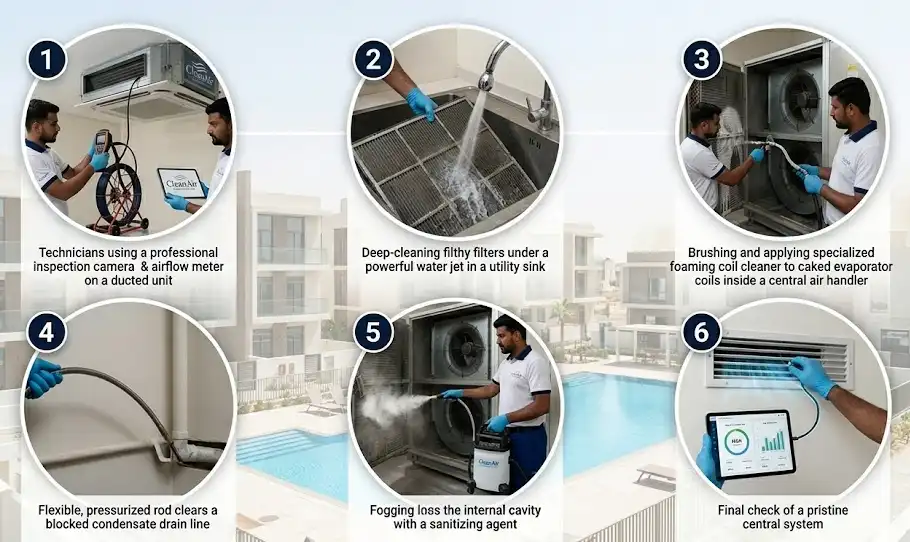
Fix: A technician clears the line using a vacuum pump or nitrogen flush. This is usually included in a standard AC deep cleaning service.
A clogged filter restricts airflow over the evaporator coil. This causes the coil to get too cold and freeze up. When the ice eventually melts, it melts faster than the drain pan can handle, causing an overflow.
Fix: Wash or replace the filter every 4–6 weeks in Dubai’s dusty conditions. This is the one because you can often prevent yourself.
Linked to the point above, but also caused by low refrigerant levels or restricted airflow from blocked vents. A frozen coil that thaws out will release more water than the drain system is designed to handle at once.
Fix: Turn off the AC and let it thaw fully (this can take a few hours), then have a technician check refrigerant levels and airflow to prevent it from happening again.
Over years of use, the drain pan under the evaporator coil can rust, crack, or degrade especially in older units. Once damaged, water bypasses the drain line entirely and drips straight down.
Fix: The drain pan usually needs replacement. This is more common in units older than 8–10 years.
If the indoor unit wasn’t installed with the correct slight tilt toward the drain outlet, condensate won’t flow properly and will pool and eventually spill over instead of draining.
Fix: This requires a technician to re-level or reposition the unit. It’s a common issue with units installed by unlicensed technicians.
Low refrigerant drops the pressure in the system, which can cause the evaporator coil to freeze over, leading to the same overflow issue described above once it thaws.
Fix: A licensed technician needs to locate the refrigerant leak, repair it, and recharge the system with the correct refrigerant type.
For villas and larger properties with ducted central AC, leaks can also come from condensation forming on poorly insulated ductwork, particularly in humid weather, and dripping through the ceiling.
Fix: Insulation needs to be inspected and repaired or replaced around the affected duct sections.
A leaking AC won’t damage your health directly, but ignoring it can lead to:
If you notice a leak, it’s worth addressing quickly rather than waiting for your next scheduled service.
A few quick DIY checks before calling a professional:
Beyond that, most causes clogged internal drain lines, frozen coils, refrigerant leaks, and cracked pans need professional tools and expertise to diagnose and fix safely.
Schedule Professional AC cleaning every 3–4 months in Dubai’s climate (more often for coastal or dusty areas)
Clean or replace filters monthly during peak summer use
Book an annual full inspection with Clean Air covering refrigerant levels, drain pan condition, and ductwork
Avoid setting your thermostat unusually low, which increases the risk of coil freezing
Why is my AC leaking water only in summer?
Higher humidity means your unit removes more moisture from the air, so any existing blockage or fault in the drain system becomes noticeable faster during summer months.
Is it safe to run my AC while it’s leaking?
It’s best to turn it off until the cause is identified, especially if water is near electrical components or spreading across flooring and walls.
How much does it cost to fix an AC water leak in Dubai?
Costs vary depending on the cause a simple drain line clean is inexpensive and often bundled into a standard cleaning service, while drain pan replacement or refrigerant leak repair costs more. A technician can give you an accurate quote after inspection.
Can I clean the AC coils myself?
Basic filter cleaning is fine to do yourself, but coil cleaning, duct sanitization, and drain line clearing require professional tools and expertise to avoid damaging the unit.
How often should I get my AC drain line cleaned?
Every 3–4 months is recommended in Dubai, aligned with your regular AC cleaning schedule.
Get Your AC Leak Fixed by Clean Air
If your AC is leaking water, don’t wait for it to turn into a bigger repair. Our technicians inspect the drain line, coil, filter, and refrigerant levels to find the exact cause and fix it the same day in most cases.
Book an AC inspection with Clean Air today