It is 45°C outside, humidity is climbing, and your air conditioner is running non-stop, yet the room still feels warm and sticky. If your AC is not cooling properly, you are not alone. It is one of the most common complaints from homeowners, tenants and business owners across Dubai.
The good news is that most cooling problems have a clear cause, and many can be fixed quickly once you know what to look for. In this guide, we explain the 10 most common reasons an AC stops cooling properly, what you can safely try yourself, and when it is time to call a professional.
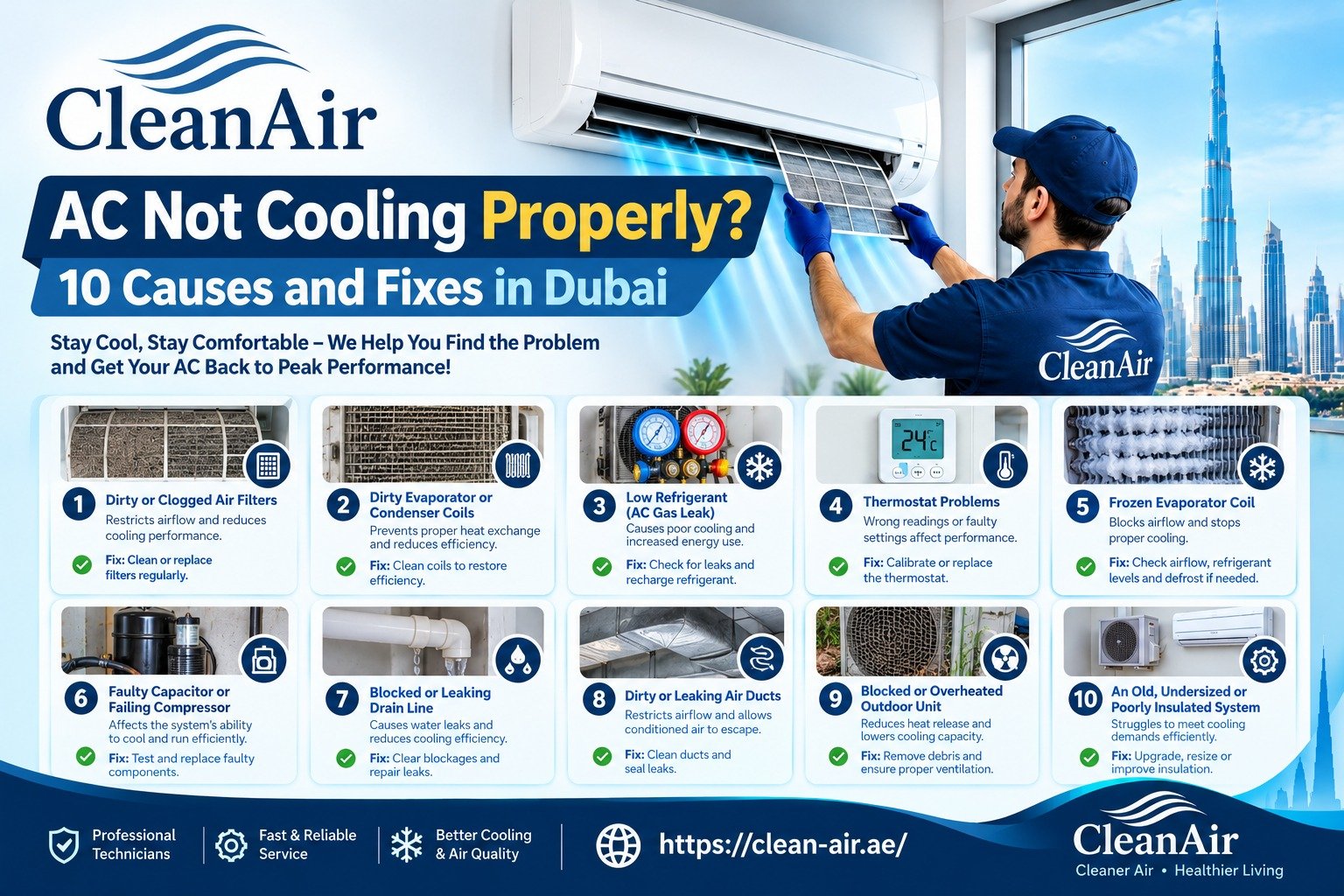
The most common reasons an AC does not cool properly are dirty filters, dirty coils, low refrigerant (gas), thermostat problems, a frozen evaporator coil, electrical faults, a blocked drain line, dirty ducts, a blocked outdoor unit, or a system that is too old or too small for the space. Dubai’s dust, sand and extreme heat make several of these problems far more likely than in milder climates.
The problem: Filters trap dust, pollen and pet hair before they enter your system. In Dubai, where fine desert dust gets into almost every home, filters clog quickly. When airflow is restricted, the AC has to work harder, cools less, and may even freeze up.
Signs:
The fix: Remove the filter, wash reusable filters with lukewarm water, let them dry fully and put them back. During peak months, reusable filters should be checked every two to three weeks. If a filter is torn or damaged, replace it.
The problem: Your AC has two sets of coils. The indoor evaporator coil absorbs heat from your room, and the outdoor condenser coil releases that heat outside. When either is covered in dust, grease or grime, heat transfer drops sharply and your AC struggles to cool.
Signs:
The fix: Coil cleaning is a job for trained technicians, because coils are delicate and the wrong method can damage the fins or push dirt deeper into the unit. A professional AC coil cleaning service removes buildup safely and can noticeably improve cooling performance.
The problem: Refrigerant is the substance that carries heat out of your home. It does not get “used up” like fuel, so if your system is low on refrigerant, there is almost always a leak somewhere.
Signs:
The fix: Do not simply top up the gas and hope for the best. A qualified technician should find and repair the leak first, then recharge the system to the correct level. Topping up without fixing the leak means the problem will come back, and you will pay for gas again.
The problem: Sometimes the AC itself is fine and the thermostat is the issue. A thermostat that is set incorrectly, has weak batteries, is poorly positioned, or has failed can make the system shut off early or run at the wrong times.
Signs:
The fix: First check that the mode is set to “Cool”, the fan is on “Auto”, and the temperature is set below the current room temperature. Replace the remote or thermostat batteries. If the problem continues, a technician can test, recalibrate or replace the thermostat.
The problem: If you see ice on your indoor unit or the refrigerant pipes, the evaporator coil has frozen. This is usually caused by restricted airflow (dirty filters or coils) or low refrigerant. A frozen coil cannot absorb heat, so the air coming out is warm or barely cool, and melting ice often causes water leaks.
Signs:
The fix: Turn the AC off and set the fan to “On” to help the ice melt. This can take a few hours. Do not chip the ice. Check and clean the filter once it has thawed. If the coil freezes again, the cause is likely low refrigerant or a deeper airflow issue, and you should book a professional inspection.
The problem: The compressor is the heart of your AC, and the capacitor gives it the electrical boost it needs to start and run. Extreme Dubai summers put heavy strain on both. If either fails, the outdoor unit may hum, struggle or not start at all, and the indoor unit may blow only room-temperature air.
Signs:
The fix: Electrical components and compressors should only be handled by qualified technicians. A failed capacitor is usually a quick and affordable repair. A failed compressor is more serious, and your technician can advise whether repair or replacement makes more financial sense, especially on older units.
The problem: Your AC removes moisture from the air, and that water leaves through a drain line. In humid conditions the line can clog with algae, dust and sludge. A blocked drain can cause leaks, trigger a safety shutoff, and reduce cooling performance.
Signs:
The fix: A technician can clear the drain line and clean the drain pan. Regular servicing prevents buildup and avoids water damage to ceilings and walls.
The problem: If you have a ducted or central AC system, the ducts deliver cool air to each room. Dust and debris inside the ducts can restrict airflow, while gaps, cracks or disconnected sections can leak cool air before it reaches your rooms.
Signs:
The fix: Professional AC duct cleaning clears buildup and restores airflow. A technician can also inspect for leaks or damage in the ductwork.
The problem: The outdoor unit needs space and airflow to release heat. In Dubai, it can be blocked by dust, sand, debris, plants, or equipment stored nearby. In extreme heat, or when installed in direct sun or a tight enclosed space, the unit may struggle to shed heat and cooling suffers.
Signs:
The fix: Keep at least a meter of clear space around the outdoor unit and remove debris. Providing shade, without blocking airflow, can help. Have the condenser coil cleaned regularly, especially after dust storms.
The problem: Sometimes the AC is working exactly as designed, but it simply cannot keep up. Units lose efficiency with age, typically after 10 to 15 years. A system that is too small for the room, or a home with poor insulation, large sun-facing windows or gaps around doors, will struggle in Dubai’s heat.
Signs:
The fix: Improve insulation, use blinds or window film to reduce heat gain, and seal gaps. If your unit is old or the wrong size, a technician can assess whether a repair or replacement is the better long-term option.
When to Call a Professional
Call a qualified AC technician right away if you notice any of the following:
Avoid opening the unit or handling electrical parts and refrigerant yourself. It is unsafe and can make the problem worse or void your warranty.
How to Prevent Your AC from Losing Cooling Power
Most cooling problems are preventable. In Dubai’s dusty, hot climate, regular care makes a real difference:
Well-maintained systems also use less electricity, which can help keep your DEWA bill down.
Need Help With an AC That Is Not Cooling?
If your AC is blowing warm air, taking too long to cool, or leaking water, do not wait for a complete breakdown. Clean Air technicians diagnose the problem, explain it clearly, and fix it with European-standard service across Dubai.
Call or WhatsApp: +971 54 214 0166
Email: info@clean-air.ae
Explore our AC Maintenance Services or view our AC cleaning prices in Dubai.
Why is my AC running but not cooling?
The most common causes are dirty filters, dirty coils, low refrigerant, a faulty thermostat or a failing capacitor or compressor. Start by checking the thermostat settings and cleaning the filter. If the AC is still not cooling, a technician should inspect the coils and refrigerant level.
Why is my AC blowing warm air in Dubai?
Warm air usually points to low refrigerant, a dirty condenser coil, a frozen evaporator coil, or an outdoor unit that is not running. In extreme summer heat, a unit that is overworked, dirty or undersized may also struggle to produce cold air.
Can a dirty AC filter stop my AC from cooling?
Yes. A clogged filter restricts airflow, which reduces cooling and can cause the evaporator coil to freeze. Cleaning or replacing the filter is the easiest first fix, and it often improves cooling right away.
How do I know if my AC needs gas?
Signs of low refrigerant include warm air, ice on the pipes or indoor unit, hissing sounds, and cooling that gradually gets worse. Because refrigerant does not get used up, low levels mean there is a leak. Have a technician repair the leak before recharging the system.
Why is there ice on my AC unit?
Ice means the evaporator coil has frozen, usually because of poor airflow from dirty filters or coils, or because of low refrigerant. Switch the AC off, let it thaw completely, clean the filter, and book a professional inspection if the ice returns.
Why is my AC not cooling the whole house?
Uneven cooling often comes from dirty or leaking ducts, blocked vents, an undersized unit, or poor insulation. A duct inspection and cleaning can help, and a technician can check whether your system is right for the size of your home.